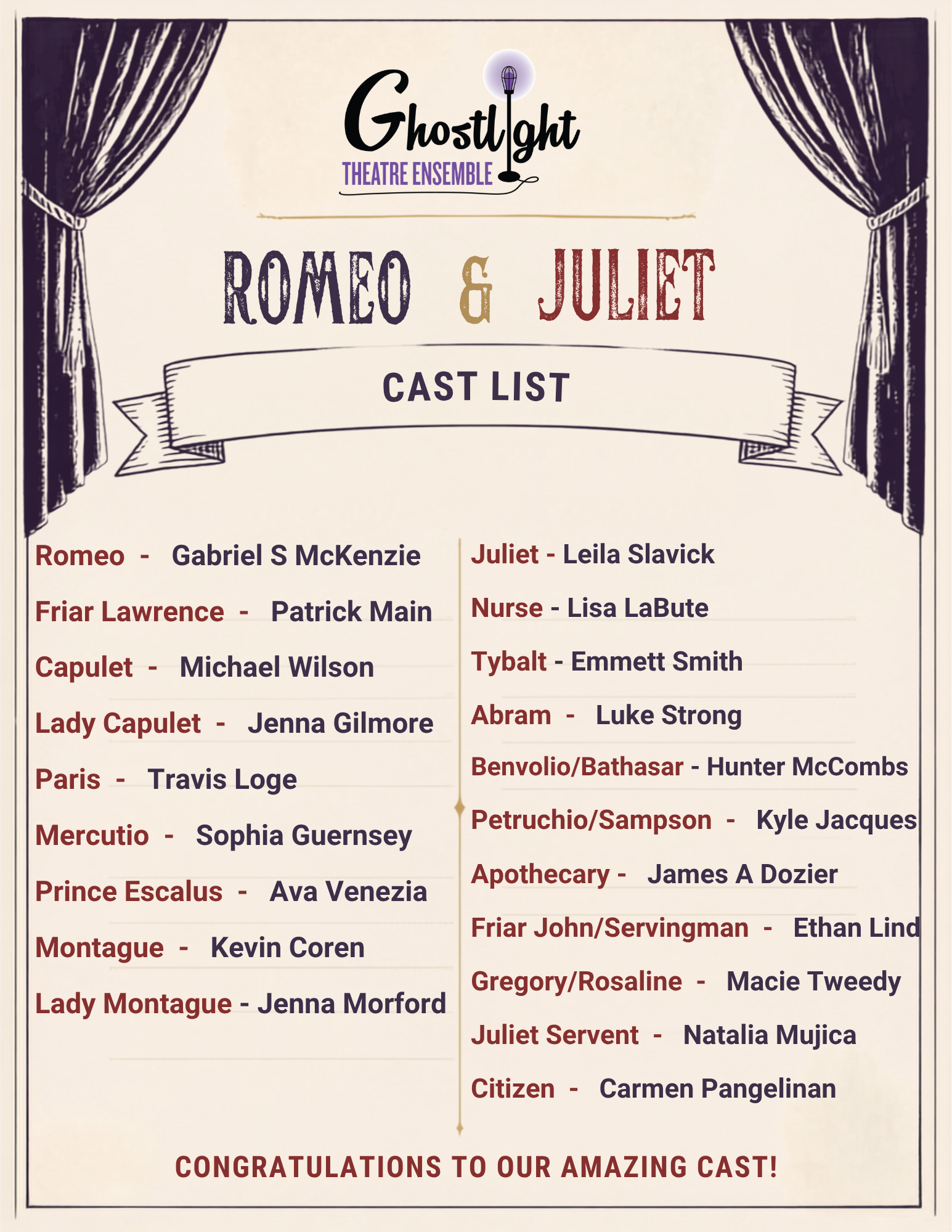

Romeo & Juliet
A Timeless Story Set In Modern Times
About
A Timeless Story Set In Modern Brentwood.
Ghostlight Theatre Ensemble invites you to be part of a bold new reimagining of one of the world's greatest love stories. While remaining true to Shakespeare's unforgettable language and timeless themes of love, family, loyalty, rivalry, and forgiveness, our production of Romeo & Juliet transports the story into present-day Brentwood, where familiar places, recognizable community landmarks, and modern-day relationships breathe new life into this classic tale.
What happens when the Montagues and Capulets become two families rooted in our own community? How do social pressures, family expectations, friendships, and first love look through the lens of today's world? This fresh interpretation proves that although the setting has changed, the emotions, struggles, and hope at the heart of Romeo & Juliet are just as powerful and relevant now as they were more than 400 years ago.
Auditions are open to performers ages 16 and older, regardless of experience. Whether you're a seasoned actor or stepping onto the stage for the very first time, there's a place for you in this production. We're looking for a diverse cast that reflects the talent, voices, and heart of the Bay Area as we bring this timeless story to life in a fresh, modern way.
Join us in celebrating the power of theatre, storytelling, and community as we reimagine one of Shakespeare's greatest works through the spirit of the Bay Area.
Audition Information
Initial Audition Dates: August 25 & 26
Callbacks: August 28, 6:00–9:00 PM - by invitation
Performances: January 15, 16, 17, 22, 23 & 24
Next Steps:
Sign up for an audition time slot HERE
Once you’ve selected your time slot, please complete the audition form HERE
Please bring a copy of your acting résumé to your audition. No headshot is needed. We'll take your photo when you arrive.
Please come prepared with a Shakespearean monologue of your choice (example below)
To submit a video audition, please fill out the audition form and email a link to your video to romeoandjulietGTE@gmail.com
Thank you again for your interest in being part of Romeo & Juliet. We look forward to seeing you at auditions!
Monologue Example:
With your monologue choice, we ask you to do 10-15 "lines." No longer than 1 minute. It can come from Romeo and Juliet, a sonnet or any other Shakespeare show; we just want to hear you speak ‘Shakespearean’. Here's an example:
HELENA from A Midsummer Night’s Dream
How happy some o'er other some can be!
Through Athens I am thought as fair as she.
But what of that? Demetrius thinks not so.
He will not know what all but he do know.
And as he errs, doting on Hermia’s eyes,
So I, admiring of his qualities.
Things base and vile, holding no quantity,
Love can transpose to form and dignity.
Love looks not with the eyes but with the mind.
And therefore is winged Cupid painted blind.
Nor hath Love’s mind of any judgment taste—
Wings and no eyes figure unheedy haste.
And therefore is Love said to be a child,
Because in choice he is so oft beguiled.
Romeo & Juliet Character Breakdown
Romeo (m:appears 16-18)
The son and heir of Montague and Lady Montague. A young man of about 16, Romeo is handsome, intelligent, and sensitive. Though impulsive and immature, his idealism and passion make him an extremely likable character. He lives in the middle of a violent feud between his family and the Capulets, but he is not at all interested in violence. His only interest is love. Romeo is also an affectionate and devoted friend to his relative Benvolio, Mercutio, and Friar Lawrence.
Juliet (f:appears 16-18)
The daughter of Capulet and Lady Capulet. A beautiful girl, Juliet begins the play as a naïve child who has thought little about love and marriage, but she grows up quickly upon falling in love with Romeo, the son of her family’s great enemy. She shows amazing courage in trusting her entire life and future to Romeo, even refusing to believe the worst reports about him after he gets involved in a fight with her cousin. Juliet’s closest friend and confidant is her nurse, though she’s willing to shut the Nurse out of her life the moment the Nurse turns against Romeo.
Friar Lawrence (m:40-60)
A Franciscan friar, friend to both Romeo and Juliet. Kind, civic-minded, a proponent of moderation, and always ready with a plan, Friar Lawrence secretly marries the impassioned lovers in hopes that the union might eventually bring peace to Verona. As well as being a Catholic holy man, Friar Lawrence is also an expert in the use of seemingly mystical potions and herbs.
Mercutio (m:18-25)
A kinsman to the Prince, and Romeo’s close friend. One of the most extraordinary characters in all of Shakespeare’s plays, Mercutio overflows with imagination, wit, and, at times, a strange, biting satire and brooding fervor. Mercutio loves wordplay, especially sexual double entendres. He can be quite hotheaded, and hates people who are affected, pretentious, or obsessed with the latest fashions. He finds Romeo’s romanticized ideas about love tiresome and tries to convince Romeo to view love as a simple matter of sexual appetite.
The Nurse (f:40-60)
Juliet’s nurse, the woman who has cared for Juliet her entire life. A vulgar, long-winded, and sentimental character, the Nurse provides comic relief with her frequently inappropriate remarks and speeches. But, until a disagreement near the play’s end, the Nurse is Juliet’s faithful confidante and loyal intermediary in Juliet’s affair with Romeo. The Nurse believes in love and wants Juliet to have a nice-looking husband, but the idea that Juliet would want to sacrifice herself for love is incomprehensible to her.
Tybalt (m:20-30)
A Capulet, Juliet’s cousin on her mother’s side. Vain, fashionable, supremely aware of courtesy and the lack of it, he becomes aggressive, violent, and quick to draw his sword when he feels his pride has been injured. Once drawn, his sword is something to be feared. He loathes Montagues.
Benvolio (m:18-25)
Montague’s nephew, Romeo’s cousin and thoughtful friend. Benvolio makes a genuine effort to defuse violent scenes in public places, though Mercutio accuses him of having a nasty temper in private. He spends most of the play trying to help Romeo get his mind off Rosaline, even after Romeo has fallen in love with Juliet.
Capulet (m:40-60)
The patriarch of the Capulet family, father of Juliet, husband of Lady Capulet, and enemy, for unexplained reasons, of Montague. He truly loves his daughter, though he is not well acquainted with Juliet’s thoughts or feelings, and seems to think that what is best for her is a “good” match with Paris. Often prudent, he commands respect and propriety, but he is liable to fly into a rage when either is lacking.
Lady Capulet (f:30-40)
Juliet’s mother, Capulet’s wife. A woman who herself married young, she is eager to see her daughter marry Paris. She is an ineffectual mother, relying on the Nurse for moral and pragmatic support.
Montague (m:40-60)
Romeo’s father, the patriarch of the Montague clan and bitter enemy of Capulet. At the beginning of the play, he is chiefly concerned about Romeo’s melancholy.
Lady Montague (f:30-40)
Romeo’s mother, Montague’s wife. She dies of grief after Romeo is exiled from Verona.
Paris (m:18-25)
A count and kinsman of the Prince, and the suitor of Juliet most preferred by Capulet. Once Capulet has promised him he can marry Juliet, he behaves very presumptuous toward her, acting as if they are already married.
Prince Escalus (m:30-45)
The Prince of Verona. A kinsman of Mercutio and Paris. As the seat of political power in Verona, he is concerned about maintaining the public peace at all costs.
Friar John (m:35-50)
A Franciscan friar charged by Friar Lawrence with taking the news of Juliet’s false death to Romeo in Mantua. Friar John is held up in a quarantined house, and the message never reaches Romeo.
Balthasar (m:18-25)
Romeo’s dedicated servant, who brings Romeo the news of Juliet’s death, unaware that her death is a ruse.
Sampson and Gregory (m:16-20)
Two servants of the house of Capulet, who, like their master, hate the Montagues. At the outset of the play, they successfully provoke some Montague men into a fight.
Abram (m:16-20)
Montague’s servant, who fights with Sampson and Gregory in the first scene of the play.
The Apothecary (m/f:30-60)
An apothecary in Mantua. Had he been wealthier, he might have been able to afford to value his morals more than money, and refused to sell poison to Romeo.
The Chorus (m/f:30-70)
The Chorus is a single character who, as developed in Greek drama, functions as a narrator offering commentary on the play’s plot and themes.
Ensemble (m/f:16-70)
Needed for dance/party and fight scenes
Servingman (m: 18-25)